
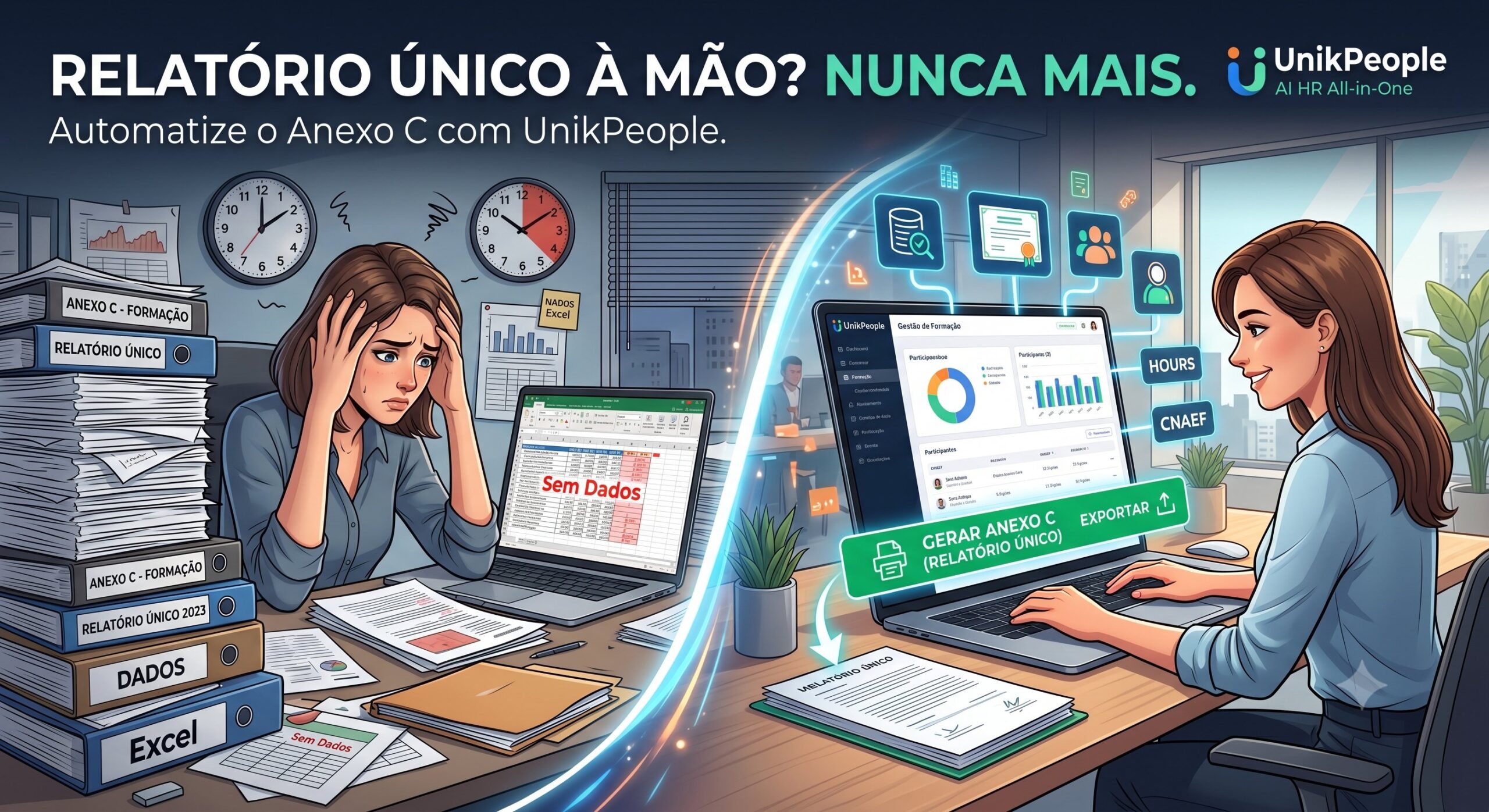
Every year, the same race against the clock. For HR teams without a system that automates the process, the outcome is always the same: days of intensive work, data scattered across Excel spreadsheets, emails requesting confirmations that arrive too late, and a training annex built by hand, line by line, employee by employee. The question is not whether there were errors — it is how many.
There is an alternative. And UnikPeople shows exactly how.
The Scene Every HR Team Knows
It is February or March. The Annual Report deadline is approaching. The HR manager opens the Excel file she has been using for years to record training. There are missing columns. There are duplicate rows. There are training sessions that took place in October but were never logged because the external trainer never sent the attendance list. There are employees who left mid-year whose data remained in a previous version of the file, saved in another folder.
Then the real work begins: consolidating everything. Cross-referencing training data with personnel files to obtain each participant’s tax identification number, department, employment status, and social security situation. Determining whether each training session was employer-initiated or employee-initiated. Calculating hours by modality — in-person, e-learning, on-the-job training. Verifying whether the training provider had a valid certification number at the time of the session.
And all of this, company by company. Because if the organisation is a group with several entities, the Annual Report is not one — there are as many as there are legal entities. Each with its own process, its own data, its own separate submission on the regulatory platform.
For a company with one hundred employees and a modest training plan, this process takes days. For a group with five hundred employees spread across three or four companies, it can take weeks. And in the end, there is always the uncomfortable feeling that some data may not be entirely correct — but there is no time left to check.
This scenario is not an exception. It is the norm for the majority of organisations that still manage training with generic tools.
What the Annual Report Really Is — and Why It Is So Demanding
The Annual Report is the mandatory annual obligation for companies to report to the labour authority. It is not a simple form: it is a set of annexes covering very different dimensions of the employment relationship, from company and employee characterisation to workplace accidents, through remuneration, working hours, and training activities.
Each annex has its own logic, its mandatory fields, its reference codes. Annex A characterises the company and establishment. Annex B covers remuneration, overtime, and absences. Annex D records workplace accidents. Annex E covers occupational diseases. Annex F covers strikes.
And then there is Annex C — the vocational training annex.
This is where most HR teams feel the greatest pressure. Annex C requires a detailed record of each training activity carried out during the year: its designation, the education and training area according to the national classification, the training modality, the promoting and training entities, whether the initiative came from the employer or the employee, the total number of hours, and — line by line — each participant’s identification with their respective training hours, attendance status (complete, incomplete, passed, failed) and whether the training was certified.
For corporate groups, there is an additional layer of complexity: the data must be segregated by legal entity. Even if a training session brought together employees from three companies in the group, each company can only report its own participants in its own Annual Report. This means that a single training activity can generate entries in three distinct reports — and all must be correct, consistent, and complete.
The True Cost of “Doing It by Hand”
The most obvious cost of the manual process is time. But the most dangerous cost is risk.
The Labour Code establishes that each employee is entitled to a minimum of 40 hours of continuous training per year. Unrealised hours accumulate as credit, with a maximum limit of three or five years depending on the regime. If that credit is not used and the employment contract ends, the company may be required to compensate the employee for the corresponding amount.
A company that does not have real-time visibility over each employee’s training balances — because the data is scattered across various files, updated irregularly, without a systematic process for closing training activities — is not only creating work for itself at Annual Report time. It is accumulating financial and legal risk that will only become visible when it is too late to correct.
To this we must add the risk of non-compliance in the report submission itself. Incorrect data, missing fields, or inconsistencies between what is declared in the Annual Report and what appears in other official records can result in fines and administrative proceedings. The labour authority has been increasing its capacity to cross-reference data, and an incorrect declaration no longer goes unnoticed as easily as it did ten years ago.
There is also a less visible but equally real cost: the opportunity cost. An HR team that spends weeks each year building reports manually is a team that is not working on organisational development, talent retention, or strategic competency planning. Compliance bureaucracy consumes the time that should be dedicated to people.
And then there is the human cost of error. When an auditor detects inconsistencies between what was declared in the Annual Report and what was reported in other systems — for example, differences between declared training hours and attendance records — the organisation faces not just an administrative fine. It faces a process that consumes energy, credibility, and management attention for months. Most of these errors are not intentional: they are the natural result of data managed in silos, updated by different people, with different criteria, at different times. The solution is not to ask teams for more care — it is to eliminate the manual process that makes errors inevitable.
UnikPeople and the Different Approach
The UnikPeople Training Management module was designed from a simple premise: the information needed for the Annual Report should not be collected at the end of the year — it should be recorded throughout the year, as a natural consequence of the training management process.
The difference may seem subtle, but its implications are profound.
When a training activity is created in UnikPeople, the mandatory fields for Annex C are an integral part of the creation form: the classification area, the modality, the training provider, the initiative. These are not fields that someone will fill in retrospectively in March from memory — they are fields that the HR manager fills in in January, when creating the activity, because they are part of the normal planning process.
When a trainer closes an in-person session — recording each participant’s attendance, absences, and grades — they are simultaneously generating the data that will feed Annex C. Each participant’s attendance status (complete, incomplete, passed, failed) is recorded at that moment, individually, with a timestamp. There is nothing to deduce afterwards.
When an employee completes an e-learning course on the portal, the system automatically records the completion date, quiz assessment result, and number of hours. No manual intervention is needed — the record happens in real time, as a direct consequence of the employee’s action.
The result? When the Annual Report deadline opens, all the data is already there. Annex C is not built — it is exported.
From Catalogue to Report: A Closed Loop
The module’s architecture ensures that each piece of information enters the system exactly once, at the right time, by the right person — and remains available for all subsequent processes without the need for manual re-entry.
The cycle begins with the training catalogue: a centralised repository of all training available in the organisation, with subject area, qualification level, modality, and company visibility configured from the start. In corporate groups, each company sees only the training relevant to it, without visual noise.
From the catalogue, HR creates specific training activities: dates, available places, training provider, participants. Enrolment can be done in bulk — by company, by department, by role profile — with automatic notification to each employee. Participants confirm attendance through the portal, without emails or phone calls.
During training, each participant’s journey is recorded in real time: for e-learning, progress is automatic; for in-person sessions, the trainer closes the activity with individual attendance and assessment records.
After closure, the system automatically triggers the next steps — satisfaction surveys, effectiveness assessments by the direct manager, update of training hour balances, completion notifications — and marks the activity as completed with all the data needed for reporting.
At year-end, the training balance dashboard presents, for each employee, hours completed, accumulated credit, and status regarding the legal obligation. HR does not need to calculate anything — the system calculates. And if an employee is at risk of non-compliance before year-end, the system flags it before the deadline expires.
The export for the Annual Report — including Annex C — is generated by legal entity. In a group with four companies, four files are generated, each with the correct data for the respective entity, automatically segregated even when participants in a training activity belong to different companies.
Corporate Groups: When Complexity Multiplies
Training management in corporate groups is, by nature, more complex than in a single company. UnikPeople was designed from the outset for this context — and that makes all the difference when the Annual Report is due.
In a group reality, it is common for a training activity to bring together employees from different entities. A leadership course may have participants from the parent company and two subsidiaries. A technical certification may be relevant to all operational units, regardless of their legal personality.
UnikPeople handles this reality natively: a single training activity can have participants from multiple group companies, with the correct record of each participant’s legal entity. At the time of export for the Annual Report, the system knows exactly which participants belong to each company — and generates the correct data for each report, without any manual separation.
The same applies to effectiveness assessment: when the system sends the assessment form to each participant’s direct manager, it does so with correct routing — each manager receives only the assessment for their employees, regardless of which company organised the activity. In groups with hierarchical structures that cross legal entities, this automatic routing would be impractical to manage manually.
The result, at year-end, is a set of reports by legal entity that are correct, consistent with each other, and complete — without anyone having had to build them.
Beyond Compliance: A Strategic Function
The Annual Report is a legal obligation. But the data that feeds that report, when well managed, is much more than that.
A training management module that works throughout the year — and not just in the month before the reporting deadline — generates strategic information that most organisations never get to explore.
What is the training completion rate by department? Which areas is the organisation investing most in? What is the correlation between training participation and individual performance indicators? Which employees have training credits about to expire? Where are the skills gaps that no training plan is yet covering?
The UnikPeople management dashboard presents these indicators in real time, without the need to build manual reports. HR and the board have visibility over what is happening, what is planned, and what is at risk — and can make decisions based on real data, not estimates built from memory and intuition.
Integration with other platform modules — namely attendance and the organisational chart — ensures that training data is contextualised within each employee’s complete profile. Training is not an isolated event: it is a moment in a person’s development journey that can impact their performance rating, career progression, and eligibility for certain roles.
When training management is done this way — integrated, continuous, data-driven — it ceases to be an administrative support function and becomes a strategic organisational development function.
The Next Annual Report Can Be Different
The deadline has passed. For many teams, it was another year of intensive work, imperfect data, and late nights checking Excel rows. The relief when submission is confirmed lasts briefly — because in a few months, the cycle begins again.
But it does not have to be this way.
What UnikPeople offers is not just a tool to generate the Annual Report faster. It is a completely different way of managing training — where reporting is a natural consequence of a process that works well throughout the year, not an extraordinary effort concentrated in the last weeks before the deadline.
Annex C is, in some ways, a mirror of the maturity of an organisation’s training management processes. When it is built by hand, it reveals that training is not managed — it is merely executed. When it is generated automatically, with correct and complete data, it reveals that training has an owner, a process, and a structure that work independently of the reporting deadline.
For the HR teams that this year experienced yet another month of manual work, the question worth asking is simple: next year, do we want to repeat the same process — or do we want Annex C to appear automatically generated, with all the correct data, ready for export?
The answer, for those who have been through the experience, is almost always the same.
The UnikPeople Training Management module is part of the UnikPeople AI HR All-in-One platform by Uniksystem. To learn more about how you can transform training management in your organisation, contact our team.
Uniksystem — Technology at the service of people and organisations.